

| Calls at UNGA for urgent action on economic crisis |
|
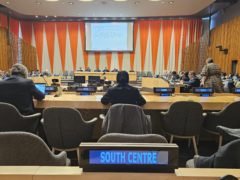
[South Bulletin 63 Article] The United Nations General Assembly held a high-level thematic debate on the "state of the world economy and finance in 2012" on 17-18 May in New York. Speakers included a range of ministers and government officials, heads of state from Albania, Guyana, Panama and Bosnia and Herzegovina, the UN Secretary-General, President of the European Commission, international agency leaders and experts, including the former head of the US Federal Reserve, Paul Volcker, and prominent economist Prof. Joseph Stiglitz. By Bhumika Muchhala The objective of the high-level thematic debate was to generate views and build consensus, under the aegis of the UN, on a way forward from the myriad challenges facing the global economic and financial situation and its impact on development, including its social repercussions. The debate featured a plenary session, where some heads of state, ministers and high-level government officials made speeches. There were also four roundtables over two days, with two roundtables occurring simultaneously over three hour periods. UN Secretary-General Ban Ki-Moon said that although recovery is often spoken about, it is for the most part a jobless recovery. In too many places, poverty and inequality are on the rise and hard-won development gains are in threat. The big picture tells us that the old model is broken and a new model needs to be created for dynamic growth, which is a growth model that will benefit current and future generations and that will respect planetary boundaries. Worldwide, more than 400 million new jobs will be necessary in the next decade. From the Arab awakening to the Occupy Wall Street protests, people are taking to the streets. "We need nothing less than a revolution in our thinking based on decent jobs and opportunities for all," said the Secretary General. Twenty years ago, a roadmap for sustainable development was put forward. Since then nothing has changed. The growing scarcity of natural resources means that more people are in need of food, energy and decent jobs. Looking ahead, the Secretary-General outlined six areas that he calls crucial: (1) Global markets must work for all people, not just the world's elites; (2) Volatile food and energy prices must be contained; (3) The resilience of all countries to financial shocks must be built; (4) Financial sectors need to be better regulated and more stable; (5) Greater financial inclusion must be created by securing universal access to a wide range of financial products at reasonable prices; and (6) Developed countries cannot cut development aid. While many countries cut budget deficits, the world economy must not lose sight of the global jobs and income deficit. The President of the UN General Assembly, Nassir Abdulaziz Al-Nasser, said that the debate aims to contribute to the follow-up of the June 2009 financial crisis conference, and to serve as an example of cooperation for the goal of a strong United Nations. The global economy is at a critical junction, nearly everyday we are acutely aware that there are pressing economic and financial issues that need to be tackled. He added that this demanded more economic security, more jobs, more opportunities, more justice and more respect for the natural environment. While Member States have varied responses, "our overarching priority must be to implement a globally coordinated policy framework that charts a sustainable development roadmap of inclusivity and equity." The President of the European Commission, Jose Manuel Barroso, who was the first speaker in the official plenary, reaffirmed that "no grouping is as widely representative as the UN, and as such we should not forget Chapters 9 and 10 of the UN Charter which concerns international economic cooperation." Barroso said the global impact of the recent financial crisis was the result of deep-seated global economic imbalances. These imbalances had built up before the financial crisis started and must be corrected if recovery is to be resumed. The unprecedented sovereign debt burdens in the European Union (EU) requires fixing internal economic and financial governance structures. Barroso outlined three priorities for the Eurozone. First, the Eurozone has to stay the course to an evolving economic situation. Reducing debt is essential to rebuild confidence. Second, with regard to structural reforms, there is work to do on both the national and European levels. Third, investments need to be scaled up in order to accompany sustainability and structural reforms. Barroso asserted that the Eurozone is much more than a "mere monetary construction; it is a product of peace that is at the origin of European integration. And this political project is larger than momentary difficulties." Paul Volcker, former chief of the United States Federal Reserve, said that there can't be any doubt that the state of the world economy and finance deserves the attention of world governments, and that of that of the US government, too. "We now know that in the midst of this growth we lost sight of the growing imbalances in trade and finance. The sense of confidence in growth and the blossoming of complex financial instruments anaesthetized us in the wide gaps of imbalances between countries and the growing fiscal deficits in some particularly important countries." "That simply could not last. It all ended in a burst of speculative and financial strain. The industrialized world sank into a deep recession and a financial crisis broke loose. Recovery is slow and unemployment has plunged to unacceptable levels almost everywhere. The fragilities in Europe further complicate everything." Calling for a more international implementation of financial and banking regulations, Volcker said, "I want to emphasize that in this globalized world the need for certain consistencies in globalized approaches, especially in finance, is urgent. The action of only a few nations, even economically small nations, could undercut reforms needed internationally. Bank capital standards and accounting standards are two obvious points, but there are other regulations in banking and finance that require an international approach." Joseph Stiglitz, professor at Columbia University, reminded the General Assembly that four years ago, at the peak of the crisis, the PGA at the time, Miguel d'Escoto Brockmann of Nicaragua, assembled a Commission of Experts (which Stiglitz chaired). The report of the Commission of Experts helped shape responses to the crisis in terms of key reforms for the international financial architecture and system. Stiglitz said that while the Commission's report "did not have as much influence as I would've liked, following our report, there was a UN conference on the economic and financial crisis and its impact on development in late June of 2009, which culminated in the approval of an Outcome Document that represented the first step in a path to recovery. As the PGA said at the time, ‘We have a historical responsibility and a collective opportunity to bring new stability and sustainability to the world financial and economic order.'" Stiglitz pointed out that the world economy would not be in the dire state that it is in if the recommendations of the 2009 Outcome Document had been followed through. Nevertheless, the underlying philosophy and some of the means and objectives of the 2009 Outcome Document, and that of the report of the Commission of Experts, are still critically important. The underlying philosophy was a simple one - that a global crisis requires a global response, and the response has to be one of safeguarding economic development and social gains, and ensuring debt sustainability. The outcome document had strong language on "making the coordinated global stimulus work for all," measures to "contain the economic dimensions of the crisis, such as exacerbated debt levels, unemployment and disenfranchisement," improving monitoring and regulation of the financial sectors, and reforming the international financial architecture and economic governance overall. The recommendations focused on several key measures. Those that are worthy of highlighting at this current juncture three years later are: (i) deepening financial market regulation, such as the Volcker Rule that bans proprietary, particularly speculative, trading by commercial banks, where deposits have been used to trade on the bank's own accounts; (ii) better management of cross-border capital flows, which has since been echoed by the IMF. Stiglitz stressed that capital account regulations "have not gone far or fast enough in making the financial system safe and sound, let alone ensuring that the financial system returns to fulfilling its critical role in the economy, as servant of the economy rather than master"; (iii) the "paramount need" for a sovereign debt restructuring mechanism; (iv) the need to reform the global reserve system which has contributed to global inequities, imbalances and lack of global aggregate demand. "The importance of this was recognized by countries from around the world, but since then discussion has faded," Stiglitz noted. Stiglitz lamented that "regrettably too little has been done on the above recommendations, although it is imperative that we attack the underlying problems." Stiglitz underscored that the issue of inequality both within and between borders should be paid more attention to by the UN. The Commission of Experts underlined inequality as one of the key factors that gave rise to the crisis. Since then, the IMF has also recognized the role that inequality plays in both economic and financial instability. "My new book, The Price of Inequality, shows that we are paying a high price for global and national inequality, not only in terms of a divided society but a divided global economy that is becoming increasingly unstable," he said. Highlighting the G20's failure to live up to its myriad promises, Stiglitz said that "we need to go beyond the G20, which is a body lacking in political representation and legitimacy. What is needed is to put the G192 (the United Nations) at the center." He brought up one of the main proposals to enhance global economic governance that was proposed in the Outcome Document of the 2009 conference, that of a UN Global Economic Coordinating Council, which, if it had been created could have offered a countervailing body to the G20 characterized by a far more representative governance structure. "The Commission of Experts had in 2009 proposed the creation of a Global Economic Coordinating Council, which was well-received at the conference of June 2009. I was hopeful that the work would have begun then. What has happened since has been disappointing." "The need for these reforms today is even clearer than it was three years ago. The cost of delay is high especially in a fragile global economy. I hope this meeting will provide the impetus needed to move forward on the bold and broad agenda that was laid out in June of 2009." On the state of the world economy, Stiglitz stated that the best outlook for the eurozone right now is one of "long malaise, slow growth and stagnation." Asserting the illogic of austerity measures, Stiglitz warned that "austerity has not worked and will not work, and this should be clear. No large economy has ever recovered from an economic slowdown or downturn, let alone one of the magnitude currently facing the EU and the US, from austerity policies." It has been half a decade since the breaking of the bubble in 2007, "but economies are not only unrepaired but are also unlikely to be back on track anytime soon. In the US, there are increasingly dim prospects of recovering the growth that has been lost. The 1980s are spoken of as the ‘lost decade' for Latin America, as a result of flawed economic policies. This decade will be the lost decade for Europe and the US." Bhumika Muchhala, a Researcher with the Third World Network, attended the UNGA debate on the global economy.
|